Introduction
Research peptides are short chains of amino acids studied in laboratory environments to investigate molecular signaling, receptor interactions, and biochemical pathways. These molecules are composed of amino acids linked together by peptide bonds and play important roles in biological systems as signaling molecules, hormones, enzymes, and structural components within cells.
In laboratory research, synthetic peptides are widely used as tools to explore cellular communication, receptor activity, and molecular mechanisms. Because peptides can be precisely synthesized and modified, they allow researchers to investigate complex biological processes with high specificity.
Research peptides therefore represent an important component of modern biochemical, pharmacological, and molecular biology research.
Key Points
• Peptides are short chains of amino acids connected by peptide bonds.
• Synthetic peptides can be produced using controlled laboratory synthesis techniques.
• Research peptides are commonly used to study cellular signaling and receptor activity.
• Peptides can be designed to mimic naturally occurring biological molecules.
• Many peptides investigated in research originate from naturally occurring signaling proteins.
Molecular Structure
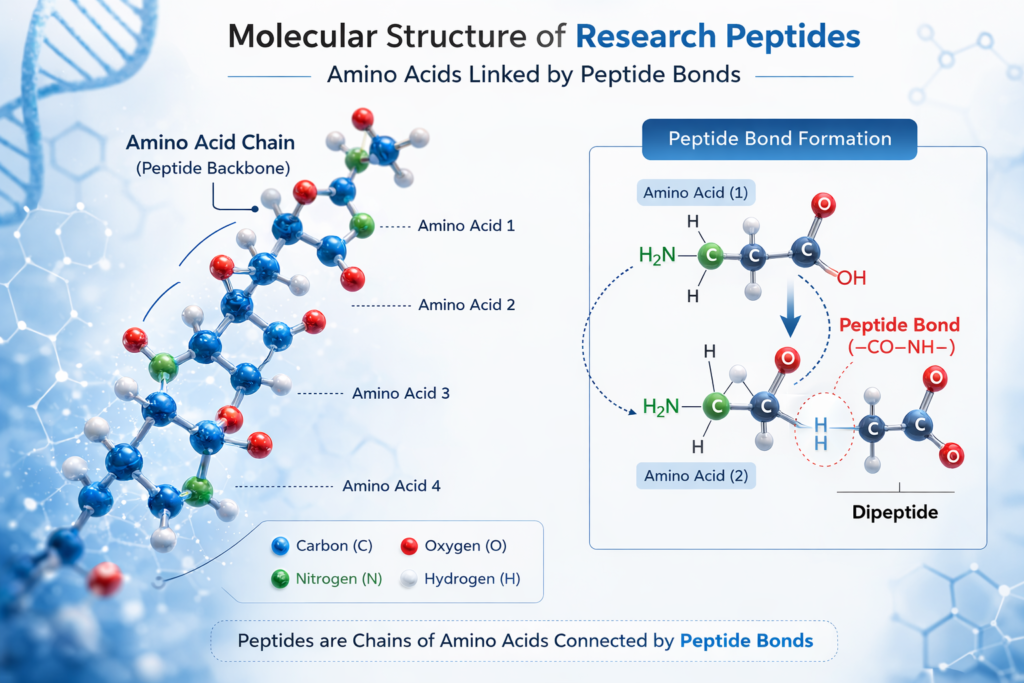
Peptides are composed of amino acids arranged in a specific sequence. Each amino acid is connected to the next through a peptide bond, forming a linear chain.
The number of amino acids determines the classification of the molecule:
• Peptides typically contain between 2 and 50 amino acids
• Polypeptides contain longer amino acid chains
• Proteins are large and complex folded structures formed from multiple peptide chains
The sequence and structure of amino acids influence how a peptide interacts with biological receptors, enzymes, and signaling pathways.
Many peptides studied in research are derived from fragments of naturally occurring proteins. These fragments can retain biological signaling properties while remaining small enough to be easily synthesized in laboratory environments.
Peptide Stability
Peptide stability is an important consideration in laboratory research. Peptides can be sensitive to environmental conditions including temperature, moisture, and enzymatic degradation.
To improve stability during storage and transport, peptides are frequently preserved through lyophilization, also known as freeze-drying. This process removes water from the peptide sample, allowing it to remain stable in powdered form for extended periods when stored under appropriate laboratory conditions.
Researchers may later reconstitute lyophilized peptides using suitable solvents when conducting experiments.
Signaling Research
Many peptides act as biological signaling molecules. In living organisms, peptide signals can regulate a wide variety of physiological processes including metabolism, cellular growth, immune responses, and neurological activity.
By studying peptide signaling pathways in controlled research environments, scientists can gain insight into:
• receptor binding mechanisms
• intracellular signaling cascades
• gene expression regulation
• metabolic pathway modulation
Synthetic peptide analogs allow researchers to investigate how small modifications to molecular structure influence signaling activity.
Synthetic Peptides in Laboratory Research
Modern peptide synthesis techniques allow researchers to produce peptides with highly controlled sequences and purity levels. The most widely used production method is solid-phase peptide synthesis (SPPS), a chemical process that builds peptide chains one amino acid at a time.
Synthetic peptides are used in a wide range of research disciplines, including:
• molecular biology
• biochemistry
• pharmacological research
• receptor signaling studies
• structural biology investigations
Because synthetic peptides can be precisely designed and modified, they provide valuable tools for exploring complex biological systems.
Conclusion
Research peptides represent an important class of molecules used to investigate biological signaling, receptor interactions, and molecular mechanisms within laboratory environments. Their relatively small size, structural flexibility, and ability to mimic naturally occurring proteins make them powerful tools for scientific study.
Advances in peptide synthesis and preservation techniques have further expanded the role of peptides in modern biochemical and pharmacological research.
Understanding the structure, stability, and signaling functions of peptides provides a foundation for exploring the wide variety of peptide compounds currently investigated in laboratory research.
References
Fosgerau, K., & Hoffmann, T. (2015).
Peptide therapeutics: current status and future directions. Drug Discovery Today.
https://pubmed.ncbi.nlm.nih.gov/25670430/
Merrifield, R. B. (1963).
Solid phase peptide synthesis. Journal of the American Chemical Society.
https://pubmed.ncbi.nlm.nih.gov/14090528/
Lau, J. L., & Dunn, M. K. (2018).
Therapeutic peptides: historical perspectives and future directions. Bioorganic & Medicinal Chemistry.
https://pubmed.ncbi.nlm.nih.gov/29706424/
National Center for Biotechnology Information (NCBI).
Peptide structure and function in biological systems.
https://www.ncbi.nlm.nih.gov/books/