
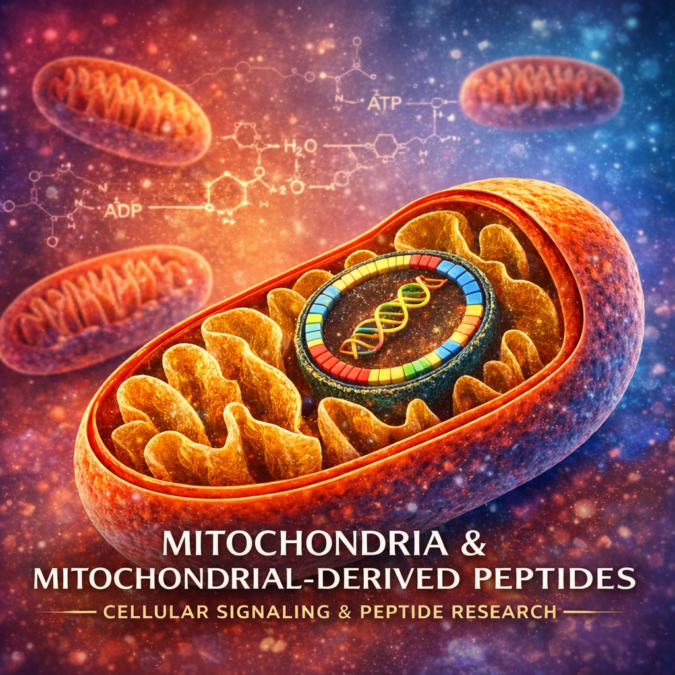
Introduction to Mitochondrial-Derived Peptides
MOTS-c is a mitochondrial-derived peptide encoded within the 12S rRNA region of mitochondrial DNA (mtDNA). Research on MOTS-c has contributed to a broader understanding of mitochondrial signaling and intracellular communication mechanisms in laboratory models.
Mitochondria are widely recognized for their role in oxidative phosphorylation and cellular ATP production. Beyond energy metabolism, mitochondria contain their own genome (mtDNA), which encodes not only components of the respiratory chain but also small signaling peptides.
These peptides, collectively referred to as mitochondrial-derived peptides (MDPs), represent an expanding area of cellular biology research. Among these, MOTS-c (Mitochondrial Open Reading Frame of the 12S rRNA Type-c) has been investigated for its role in intracellular signaling and metabolic pathway regulation within experimental systems.systems.
Molecular Origin of MOTS-c
MOTS-c is a 16-amino-acid peptide encoded within the mitochondrial 12S rRNA gene. Unlike many mitochondrial proteins that function within the organelle, MOTS-c has been observed to localize outside the mitochondria under certain experimental conditions.
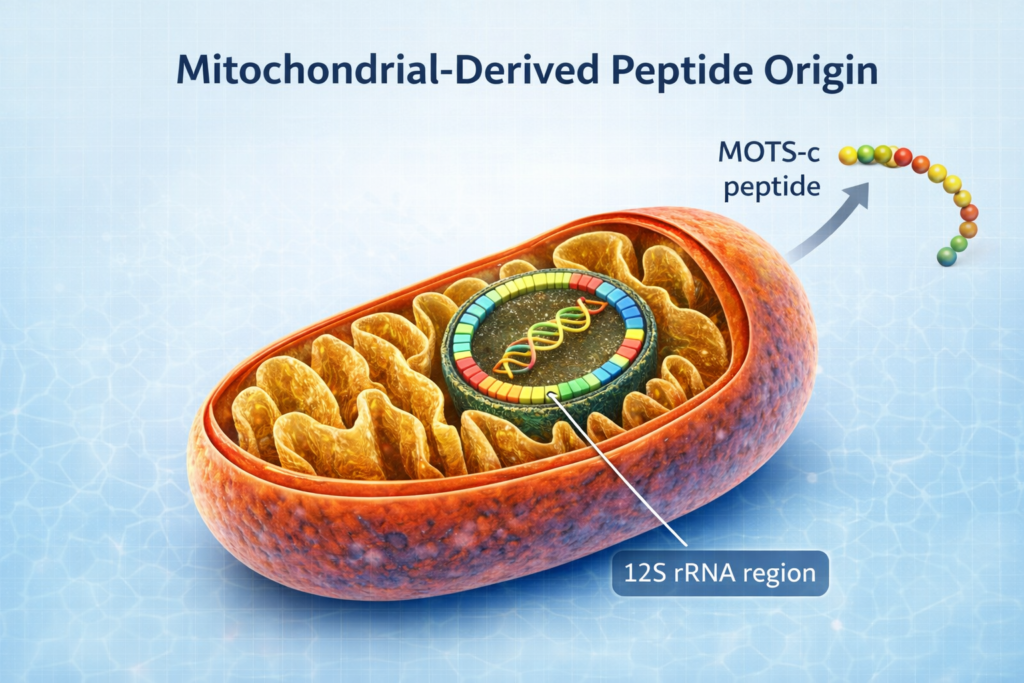
Initial characterization of MOTS-c was reported in Cell Metabolism (Lee et al., 2015), where researchers identified its expression from mtDNA and its association with cellular metabolic regulation pathways.
This discovery contributed to growing recognition that mitochondrial DNA encodes signaling molecules capable of influencing broader intracellular processes.
AMPK-Associated Signaling Pathways
Research models have demonstrated interaction between MOTS-c and AMP-activated protein kinase (AMPK), a central regulator of cellular energy sensing.
AMPK functions as an intracellular energy sensor, responding to changes in AMP/ATP ratios. Experimental findings indicate that MOTS-c may influence AMPK-related signaling cascades in response to metabolic stress conditions.
These investigations have positioned MOTS-c within broader studies examining:
- Cellular nutrient sensing
- Energy homeostasis regulation
- Metabolic signaling integration
Research in this area remains focused on mechanistic understanding within controlled laboratory environments.
Nuclear Translocation and Mitochondrial-to-Nuclear Communication
Under specific stress conditions, MOTS-c has been observed to translocate to the nucleus. Studies published in Cell Reports describe nuclear localization patterns associated with transcriptional regulation models.
These findings support the concept of mitochondrial-to-nuclear communication, in which signaling molecules encoded by mtDNA may participate in coordinated cellular stress adaptation responses.
Such cross-genomic signaling has expanded understanding of mitochondria as dynamic regulators of intracellular communication beyond their traditional bioenergetic function.
Relationship to Other Mitochondrial-Derived Peptides
MOTS-c is part of a broader class of mitochondrial-derived peptides, including:
Humanin
Encoded within the mitochondrial 16S rRNA region, Humanin has been studied in models of cellular stress signaling.
Small Humanin-Like Peptides (SHLPs)
SHLP1–6 represent additional mtDNA-encoded peptides identified within the mitochondrial genome and investigated in metabolic and cellular signaling research.
Together, these peptides highlight the expanding recognition of mitochondrial DNA as a source of biologically active signaling molecules.
Expanding Research in Mitochondrial Signaling
The identification of MOTS-c and related mitochondrial-derived peptides has contributed to a broader re-evaluation of mitochondrial function in cellular biology.
Ongoing investigations continue to explore:
- Intracellular signaling integration
- Energy-sensing pathways
- Mitochondrial stress response mechanisms
- Cross-genomic communication between mtDNA and nuclear DNA
These studies remain focused on molecular and cellular research models to better understand mitochondrial signaling networks.
References
- Lee C, et al. (2015). The mitochondrial-derived peptide MOTS-c promotes metabolic homeostasis. Cell Metabolism.
https://pubmed.ncbi.nlm.nih.gov/25738459/ - Kim KH, et al. (2018). Mitochondrial peptide MOTS-c translocates to the nucleus to regulate gene expression. Cell Reports.
https://pubmed.ncbi.nlm.nih.gov/30008320/ - Reynolds JC, et al. (2021). MOTS-c as a regulator of metabolic adaptation. Nature Communications.
https://pubmed.ncbi.nlm.nih.gov/33558652/ - Cobb LJ, et al. (2016). Identification of mitochondrial-derived peptides including SHLPs. Aging (Albany NY).
https://pubmed.ncbi.nlm.nih.gov/27225690/
Related Research Categories
Research materials associated with GLP-1 receptor signaling and incretin pathway models are grouped under: